

AI regulation in the United States is changing in a big way.
The main shift is this: the White House is pushing for one national direction for AI policy instead of letting every state make very different rules on its own. That is the core story behind the recent videos and the White House text.
This matters because AI is no longer a small tech topic. It now affects schools, business tools, websites, customer support, banking, healthcare, content creation, and even how people search for information online. When the government starts talking about one national framework, companies pay attention.
This article explains what changed, what the framework says, what is still unclear, and what businesses should do now.
What changed?
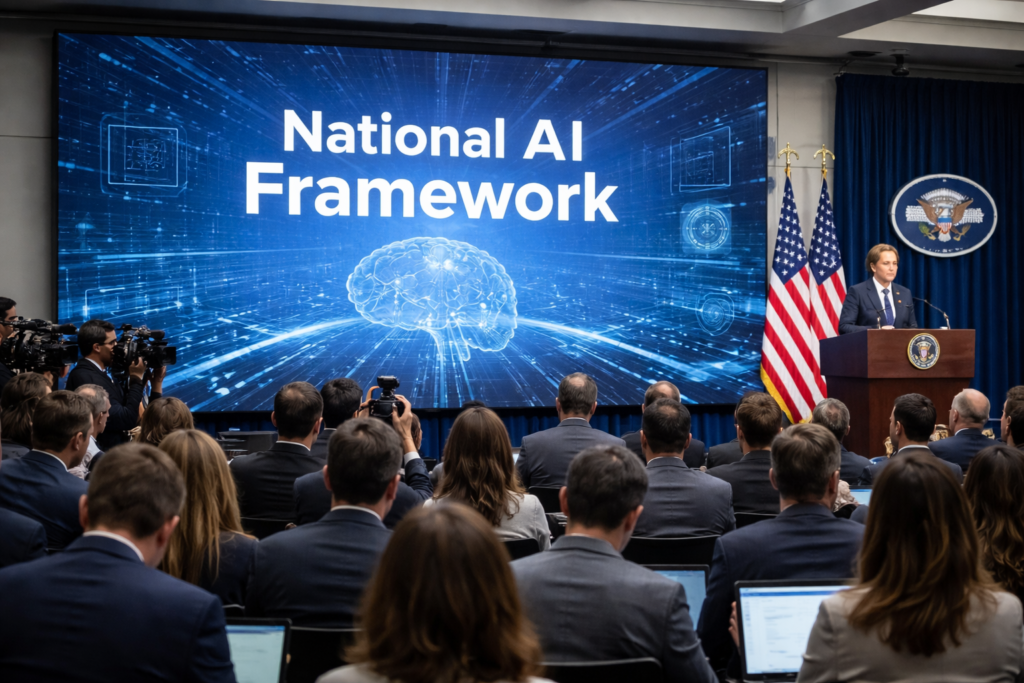
The White House released a National Artificial Intelligence Legislative Framework after an earlier executive order from President Trump that argued state-by-state AI rules were becoming too heavy and too confusing.
In simple words, the message is:
“America should not have 50 different AI rulebooks. It should move toward one main national standard.”
That is the big policy change.
Before this, many states were moving on their own. Some were adding rules about AI safety, disclosure, bias, elections, privacy, and harmful content. The White House position is that this kind of patchwork makes life harder for developers, startups, and businesses that work across the whole country.
So the new framework tries to push AI policy in a more centralized direction.
What the framework is trying to do
From the videos and the White House material you shared, the framework is built around a few clear ideas.
1. One national standard instead of many state rules
This is the center of everything.
The administration says AI developers should not have to deal with a different set of laws in every state. It wants Congress to help create one national policy direction and stop conflicting state rules from slowing AI growth.
This is not just a legal point. It is also a business point.
If a company runs a website, app, SaaS tool, chatbot, or AI product across the U.S., it becomes expensive and messy to keep changing features for different states.
2. Child safety and parental control
The framework talks a lot about children.
The goal is to give parents better tools to manage their children’s digital presence and reduce harm from AI systems. That includes stronger safety expectations around harmful content and better controls for younger users.
This part matters because AI is now showing up inside social apps, learning tools, search tools, and chat systems used by families.
3. Free speech and political content
One of the most talked-about parts in the videos is the language around partisan content.
The framework pushes against the idea that AI providers should block or suppress lawful content just because it is politically sensitive or partisan. That is why some video clips kept repeating the line about AI providers not banning partisan content.
Whether people agree with that or not, it is a major part of the policy direction.
4. Data centers and power
Another big part is infrastructure.
The framework connects AI growth to data centers, electricity use, and energy planning. In the videos, this showed up as discussion about data centers generating their own power on site or behind the meter.
That matters because modern AI is not just software. It also needs expensive hardware, chips, servers, cooling, and power. So this framework is not only about rules. It is also about building the physical backbone for AI.
5. Sector-based oversight
The framework also says AI should not always be handled by one giant new AI regulator.
Instead, it leans toward sector-based oversight. That means industries like finance, healthcare, education, or communications may be watched by their own existing regulators.
That is important because it tells businesses something very practical:
AI compliance may depend on what kind of business you run, not just what model you use.
A hospital, a law firm, and an ecommerce brand may all use AI, but they will not face the exact same risks.
6. Education and workforce readiness
The videos also mentioned preparing Americans for an AI-ready workforce.
That means the government is not treating AI as a short-term trend. It sees AI as something that will affect jobs, education, and skills for years.
That is why this topic is not just news for today. It is part of a bigger long-term shift.

Is this already a final national AI law?
No. And this part is important.
The framework is a policy push and legislative roadmap. It shows the direction the administration wants. It does not automatically mean one final national AI law is fully done and settled.
So the smart way to explain it is this:
The White House is trying to move the U.S. toward a national AI framework, but the legal and political process still matters.
That means businesses should pay attention now, but they should also understand that regulation can still change through Congress, courts, agencies, and state-level action.
Why this matters even after the news cycle passes
This topic is useful even one month later, three months later, or more, because the real issue is bigger than one press release.
The real issue is this:
- Who gets to set AI rules in America?
- The federal government?
- The states?
- Industry regulators?
- Courts?
- Or all of them together?
That question is not going away.
The new framework matters because it shows the current White House wants lighter, more centralized, more growth-focused AI policy. That gives businesses a strong signal about where the administration wants to go.
Even if details change later, this policy direction is important because it affects planning.
A company building AI into its business now has to think about:
- where its model runs
- how user data is handled
- whether outputs are logged
- what safety controls exist
- what happens if rules change by sector
- whether dependence on outside API providers is too risky
So this is not just a news headline. It is a planning signal.
What businesses should take from this
Businesses should not read this framework and think only, “Okay, new politics.”
They should think:
“How do we make our AI setup safer, cleaner, and easier to control?”
That is the real business takeaway.
A company that depends fully on outside AI APIs for everything may face more pressure later around cost, privacy, moderation, uptime, and compliance. A company that has better control over its stack may be in a stronger position.
That does not mean every business needs to build its own giant AI lab.
It means businesses should start asking better questions:
- Do we really need to send all our data to third-party AI providers?
- Can some tasks run on an open-source model instead?
- Do we have clear API control between our app and the model?
- Can we log and review outputs if needed?
- Are we ready if our sector gets stricter rules later?
These are practical questions, not hype questions.
A practical solution for businesses
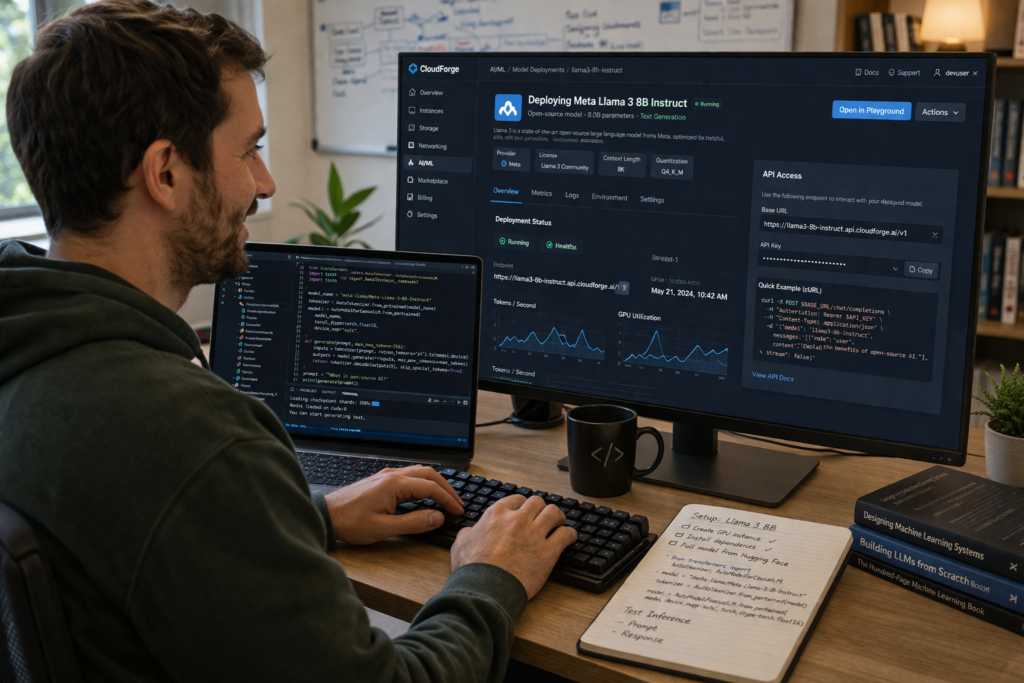
One strong solution is to move some AI work to an open-source model that the business can control more directly.
That can mean running an open-source LLM on:
- a local machine for internal use
- a private server
- a GPU service like RunPod
Then that model can be connected to a website, internal dashboard, or app through a proper backend and API layer.
This setup helps because it can give the business more control over:
- privacy
- hosting
- data flow
- integrations
- model choice
- long-term flexibility
It does not magically remove all legal questions. But it gives businesses a cleaner technical foundation, and that matters more when policy starts shifting.
What I offer
My name is Mark.
My Email Is: marky72778@gmail.com
I focus only on work I can actually do.
I can help with:
Open-source LLM hosting
I can help businesses host an open-source LLM on localhost or on a GPU service like RunPod.
Python and Django APIs
I can build Python and Django APIs so the model can connect cleanly with a website, app, or internal tool.
AI integration
I can integrate AI through APIs into an existing website or system.
Django development
I can build or extend a Django site or backend around the AI workflow.
My basic hosting and setup starts at $750.
If a client needs deeper integration with an existing site, more backend work, special API logic, or support across a different stack, that is separate work.
Final thoughts
The real story behind AI regulation news today is not just that the government said something new.
The real story is that the U.S. is moving deeper into a fight over how AI should be governed: by states, by the federal government, by existing sector regulators, or by a mix of all three.
The White House framework makes its position clear. It wants a national direction, fewer state barriers, more room for AI growth, stronger child-safety language, protection around speech issues, and more support for AI infrastructure.
That is why this topic matters beyond one week of news.
It is not only about regulation.
It is about how AI products will be built, hosted, moderated, powered, and sold in the years ahead.
And for businesses, the smartest response is not panic.
It is preparation.
A business that gets control over its AI stack early will usually be in a better position than one that waits until rules get tighter.
Sources:
click here 1: https://www.whitehouse.gov/presidential-actions/2025/12/eliminating-state-law-obstruction-of-national-artificial-intelligence-policy/
click here 3: https://www.whitehouse.gov/releases/2026/03/president-donald-j-trump-unveils-national-ai-legislative-framework/
